

A printable baseball scorecard helps you record plate appearances, baserunner progress, substitutions, and inning results. It is useful when you want a play-by-play record rather than only the final score.
Choose a card with readable batting-order rows and enough inning columns for your game. Check whether there is space for pitchers, substitutions, and a notation key. A compact sheet is easier to carry, but tiny boxes can make a detailed game difficult to follow.
Template previews and downloads
Baseball Scorecard Chart



Baseball Scorecard Example


Baseball Scorecard Free Sample


Baseball Scorecard PDF Template


Free Printable Baseball Scorecard


Baseball Scorecard PDF


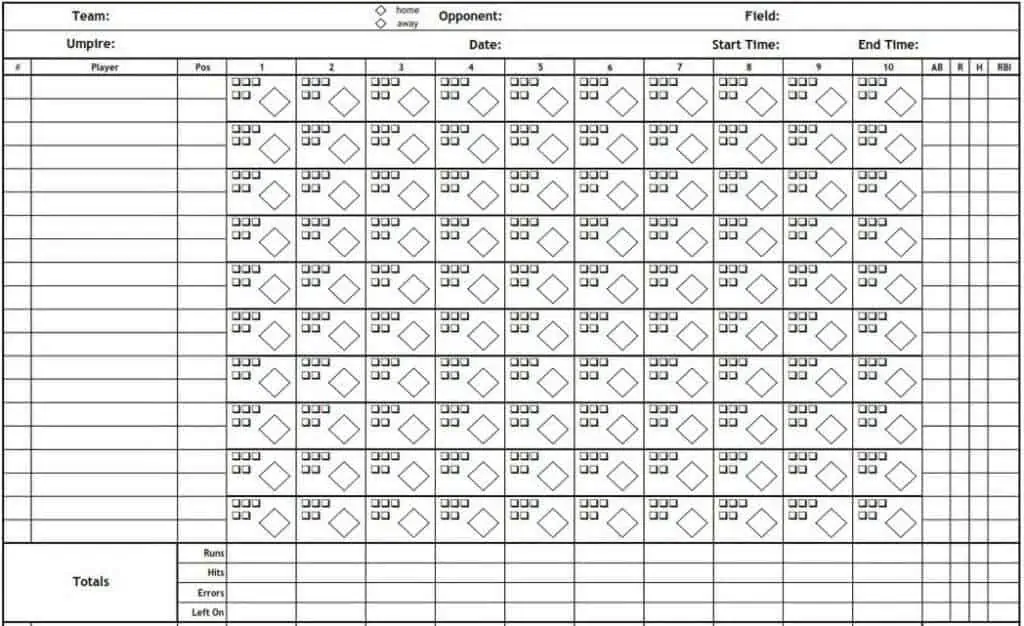
Baseball Scorecard Sample


How to use the printable baseball scorecard
Step 1. Enter the teams, date, batting order, and defensive positions before the first pitch. Use baseball score sheets if inning summaries are all you need.
Step 2. Record each plate appearance using a consistent key. Track runners through the bases and note substitutions beside the correct batting slot. Prepare scorekeeping equipment with daily checklist templates.
Step 3. At the end of each half-inning, reconcile the runs and outs before moving to the next column.
Defensive position numbers let a scorer describe a play compactly: 1 is pitcher, 2 catcher, 3 first base, 4 second base, 5 third base, 6 shortstop, and 7 through 9 the outfield positions. These numbers describe positions rather than a player’s shirt number. Use your scoring key consistently through the game.
Leave space to record a substitute in the same batting-order slot, including the inning when the change occurred. When a runner advances without a hit, record the event rather than drawing a path without explanation. This helps you distinguish walks, errors, and other advances when reviewing the card.
Example and checks
A groundout from shortstop to first base is commonly recorded as 6–3. The numbers identify fielding positions, not the score. Keep a small legend nearby if you are learning the notation.
Keep hits, errors, walks, and runs separate. Make corrections legible so another reader can reconstruct the play. Organize fixtures and practice times using weekly schedule templates.
Understand the structure of a detailed scorecard
A detailed baseball scorecard usually follows the batting order down the page and innings across it. Each plate appearance is recorded in the appropriate area, with additional marks describing what happened to the batter and any runners. Examine the selected layout before the game. Identify where player names, positions, substitutions, inning totals, and pitcher information belong. Not every printable design provides the same amount of detail. Choose one you can use clearly rather than assuming the most crowded format is automatically the best.
Decide whether you need one card for each team. Some layouts show a single lineup, while others place both teams on the same sheet. Check the number of innings and the available space for additional action. Keep a spare page if the game outgrows the printed grid. Label continuation pages with the same date, teams, and game identifier. A completed scorecard should be understandable as one record even when it consists of several pages rather than a single sheet.
Set up the batting order and notation key
Enter the starting lineup in batting order and confirm names or player identifiers from the information available. Keep shirt numbers separate from scoring position numbers if both are recorded. Add the date, venue, teams, and any relevant game reference. Establish the symbols you will use for common events before the first plate appearance. The goal is consistent interpretation, so keep a small legend available if you are learning. Avoid changing the meaning of a symbol midway through the game.
Common notation can record events compactly, but a note is useful when the symbol alone would be unclear to you later. For example, defensive position numbers describe the players involved in a fielding play rather than the score or a shirt number. A groundout recorded as 6–3 identifies shortstop to first base. The scorecard’s notation should help reconstruct the action. It should not become a guessing exercise based on symbols copied from another sheet without understanding their meaning.
Record the batter’s result and runner progress separately
The result of a plate appearance and the subsequent movement of runners are related but distinct parts of the record. A batter reaching first base does not automatically mean a hit was recorded. Similarly, a runner may advance through several events before scoring. Use the selected method to show the batter’s result, then update runner progress when later action occurs. This prevents a simplified mark from hiding how the inning developed. Keep the notation legible enough to review at the end of the half-inning.
Do not invent a hit, error, or other official decision merely because you know where a runner ended up. If a classification is uncertain and the record is intended to be official, follow the relevant scoring process. For personal notes, mark the uncertainty and seek clarification when practical. A small explanatory note can be more useful than an incorrect symbol that appears definite. Keeping the distinction between observed action and the scoring decision helps the final record remain more reliable.
Keep track of outs and the changing inning
Check the out count and the sequence of plate appearances as the half-inning progresses. A scorecard becomes difficult to interpret if entries slip into the wrong inning column. When a half-inning ends, review the batter reached in the order and identify where the next half-inning for that team will begin. Use the convention appropriate to your chosen format to show the end of the inning. Consistency matters more than decorative marks that another reader cannot interpret.
During the review, compare the recorded runner progress and run total. If a run was entered in the summary, the detailed record should support it. The exact review depends on the purpose of the card and any league requirements, but checking while the action is recent can prevent avoidable confusion. If you discover an earlier mistake, make a readable correction and update affected totals. Avoid erasing so much of the entry that neither the original issue nor the corrected result can be understood.
Handle substitutions and additional pages
A substitute should be recorded in the appropriate batting-order slot with enough context to identify when the change took effect. Keep earlier entries attributable to the original player. Do not move the entire lineup simply because a replacement enters. If the selected layout has a dedicated substitution line or area, use it consistently. Where several changes occur, a concise note can explain the sequence without crowding the main plate-appearance boxes. Follow the relevant competition’s requirements for an official record.
When the printed space is exhausted, continue on a clearly labeled additional page rather than compressing several actions into an unreadable box. Identify the inning, lineup position, and connection to the earlier page. Check that cumulative totals include the continuation entries only once. A well-organized two-page record is more useful than an apparently complete single page with missing action. This is another reason to prepare spare sheets and understand the layout before the game begins.
Check the completed card against the summary
At the end of the game, review the recorded runs inning by inning and compare them with the final total. Check any other required summaries using the appropriate underlying entries. Do not assume that a scorecard is correct merely because the final runs happen to match another source. Lineup details, event classifications, and substitutions can still contain errors. Review the aspects that matter to the intended use and retain notes about anything that remains unresolved.
Identify the game’s actual status and unused space clearly. A shortened or interrupted game should not be made to look like a full game by filling blank columns with invented results. Keep the completed record with the relevant date and teams, and retain a readable scan or photograph if that fits the organization’s process. If another scorer helped, confirm which copy is the final reference. This avoids later uncertainty when two similar cards contain different corrections or totals.
Make the printable layout comfortable to use
Print a test page and check whether you can write names and notation comfortably at the chosen size. Very small boxes can slow recording or encourage marks that cannot be read later. Landscape orientation, margins, and print scaling may affect the result, especially if a spreadsheet has been edited. Keep the page layout simple enough that the important rows and columns remain visible on a clipboard. Use a writing method that allows clear corrections and does not obscure earlier entries.
Practice with a short fictional sequence before relying on an unfamiliar template. Enter a few plate appearances, a runner advance, a substitution, and an inning total. Then ask whether the sequence can be reconstructed from your marks alone. This is a useful test of the layout and your notation method without creating pressure during a live game. The downloadable scorecards provide a starting structure; dependable scorekeeping comes from preparation, consistent symbols, timely entries, and careful review of what the record actually shows.
Keep a learning copy separate from an official record
If you are learning scorekeeping, use a practice copy to test notation and compare your interpretation with a reliable explanation. Mark it as practice so it cannot be confused with an official game record. Notes about questions or alternative interpretations can remain there while you develop a consistent method.
For an official assignment, use the required format and process for resolving uncertain scoring decisions. Do not quietly transfer guesses from a practice card into the final record. The distinction protects the usefulness of both documents: one supports learning, while the other records the game under the applicable instructions.
Review a completed practice card after some time has passed. If you cannot reconstruct an inning from your own marks, identify which label, note, or symbol was missing. That small review is a practical way to improve the next record without making the live scorecard more complicated than it needs to be.
Frequently asked questions
Do I need to know every scoring symbol?
Start with a small consistent set of symbols and add notes for unusual plays. Follow your league’s scoring conventions for official records.
Can I print one card for both teams?
Check the layout. Some cards cover one lineup only, so you may need a separate page for each team.

